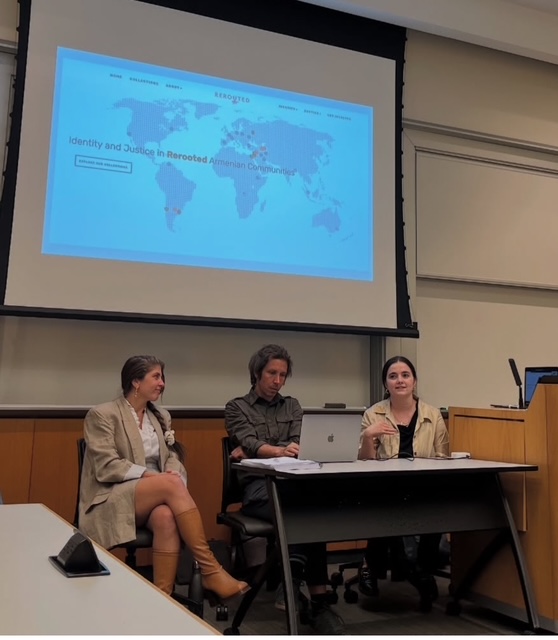
On 24 September 2023, as the first of 100,500 forcibly displaced persons and their families drove into Armenia from Artsakh, many NGOs, journalists, and civil volunteers gathered in Goris, in Armenia, to help welcome the refugees and document their arrival.
One of these NGOs was Rerooted Archive. Co-founders Anoush Baghdassarian and Ani Schug were on location to document the situation and to help the other NGOs, who were there to distribute aid, which included anything from housing to food and other necessities.
Who is Rerooted Archive?
In 2016, Anoush was working with Human Rights Watch focusing in part on Syria. Around that same time, she heard the story of a man, Souleymane Guengueng, who survived torture in Chad and who then spent more than 17 years trying to collect testimonies of all those who had also been tortured in Chad, and who tried to seek justice for the victims of these crimes. Hearing about Guegueng’s experience and work, she thought of the Armenian communities worldwide, who deserve that same kind of justice. Specifically, she wanted to document the war in Syria from the Syrian Armenian community’s perspective, as she noticed that the experiences of Syria’s minority groups were not being documented as much as those of other communities. During the summer of 2017, Anoush and Ani began that task together.
Ani explained how she and Anoush met:
“We love to tell this story ––– it feels very much like an Armenian Diaspora story. We went to college right next to each other in the Claremont Consortium. And one day I was getting lunch in the cafeteria wearing a shirt that said « Armenia » and Anoush was so excited to see that and came up to me to say “Hi!” From there, we became such close friends and founded the Armenian Students Association that met weekly for lunch. During our senior year, Anoush was planning post-graduation projects that focused around her passion for human rights and justice, particularly for the Armenian community of Syria. She knew that I also really cared about topics of language, cultural preservation, and Middle Eastern Studies so she proposed we work together, and it has been the best partnership ever since!”
In the beginning, in 2017, they began interviewing Syrian-Armenians in Armenia. When Anoush volunteered in Armenia in 2018, she interviewed friends and acquaintances they knew from the year before. In 2019, Ani and Anoush traveled to Lyon, in France, to interview Syrian-Armenians living there. Very quickly, both became overwhelmed as members of other Armenian diasporic communities, such as the Iraqi-Armenian community, approached them to share their testimonies. They decided they should begin collecting testimonies from all Armenian communities worldwide, no matter what their past is.
Logistics became necessary. Ani and Anoush reached out again and again to organizations, legal clinics, law school clinics, and university-based research centers, who focus on human rights. They first reached out to Armenian foundations to acquire grants in order to run their own projects. Afterwards, Ani explained they branched out to apply for funding from non-Armenian organizations worldwide. They also built partnerships with the clinics and research centers, to whom they had reached out. “Now,” Anoush explained, “Rerooted hosts its own volunteers on a variety of projects, collaborates with clinics on big projects, lends advice to other organizations about documentation and advocacy topics, and helps with saving and properly documenting interviews.” She further explained that the volunteers, many of whom come from different universities, regularly receive training from Rerooted. These volunteers are at the very frontlines when approaching and travelling to meet different Armenian diaspora communities, utilizing their diverse linguistic skills to interview community members from the Syrian Armenian diaspora to the South American diasporas, to Lebanon, Jerusalem, India, Singapore, and more, whilst not forgetting the Artsakhtsi Armenians, forcibly displaced by Azerbaijan between the 1990s and finally in 2023.
“With our first Syria collection, we learned how much work it takes to transcribe, translate, edit, and publish testimonies,” explained Ani. The initial gathering of Syrian-Armenians’ testimonies led Rerooted to create a template system, which is now applied to all conducted collaborative tasks. Clinics and research centers see this collaborative work and reach out directly to Rerooted Archive, which Ani describes as “really rewarding”.
Anoush explained that documenting Armenian experiences in conflict zones is a priority in their work to collect testimonies. When conflict and violence break out in a country or region, entire communities enter survival mode. People flee and their communities are at risk of disappearing. When the Syrian civil war broke out, Armenian communities broke apart, with many leaving Syria for the four corners of the world and others staying in the country. It is important to record their testimonies and keep alive the memory of Armenian presence in Syria. Gathering the testimonies of Artsakhtsi Armenians followed the same logic. When Azerbaijan slowly starved and then forcibly expelled the total population of Artsakh, Rerooted Archive responded by fact-finding and reporting the entire ordeal near and afar. As the forcibly displaced Artsakhtsi population crossed into Goris in Armenia, Rerooted came on sight to meet with them. Before gathering testimonies, the team bore witness to the crime playing in action and its immediate consequences. Anoush described the tasks she undertook during multiple fact-finding missions to Armenia: “We documented the harms from Azerbaijan in border regions of Armenia like Vardenis and Jermuk and incorporated them into public advocacy reports sent to the UN or published in collaboration with universities like Harvard and Yale.” She adds: “Before September 2023, we could only gather facts by phone with those blockaded inside Artsakh. When the Artsakhtsis were forced into Goris, we knew how important it was to collect these firsthand testimonies for exposing the truth of what was happening in the moment, seeking aid, pursuing justice, and preserving these testimonies for history and our collective memory.” It was only afterwards that Ani, Anoush, and all the volunteers began interviewing Artsakhtsi Armenians between September 2023 and December 2023. Within the Artsakhtsi community, the Artsakhtsis themselves undertake this enormous task of gathering testimonies from their fellow Artsakhtsi compatriots, Anoush explained, slowly gathering testimonies to compile together “a tapestry of memory”.
Seeking Justice – Rerooted’s Justice Work
As documenting conflict zones is a priority for Rerooted Archive, seeking justice is a necessary part of their mission. Gathering testimonies from members of communities, whether they have survived a recent conflict, genocide, or period of violence, or are simply descendants of survivors of nineteenth and twentieth century genocides is the simplest action and the first of many paving the road to defending a case in front of a judge sitting on an international court of justice. It requires minute attention to detail and extra care as those, who share their memories, are still processing the trauma, the grief, and the war crimes. It also needs to set a foundation for the actions detailed below, necessary in seeking justice.
How does one seek justice?
On its website, Rerooted Archive includes an interactive map and published reports co-written with its partners. Those reports are logged together under a “Justice” tab and are addressed to international institutions, specifically the UN at the moment. They have taken into account the testimonies gathered, supported by judicial and historical research in order to present the demands clearly explicated in each report. Testimonies are considered evidence that a crime has been committed. This is why, for example, multimedia firsthand accounts were admitted into the log by South Africa’s lawyers in January 2024 at the International Court of Justice (ICJ) in the case mounted against Israel for their genocide in Gaza. Multimedia evidence is also key in Syria, Artsakh, and Jerusalem amongst many other places worldwide, because those enduring the crimes and the wars documented and continue to document their daily struggles.
Anoush explained that the biggest difficulty in seeking justice is putting the pieces together. Firstly, one must ask the survivors pertinent questions about the perpetrator and the crime committed. Anoush explains in detail: “These pieces of information must be corroborated by the various types of evidence which neither victims and witnesses nor the interviewer have access to when the crime scene is cut off from the rest of the world. Piecing together a case against a defendant without informants or evidence beyond firsthand testimonial evidence presents many challenges.” Secondly, one must research the legal texts to find the legal causes of action pertaining to the situations described. Thirdly, those working to gather these testimonies must also keep in mind the desires of the survivors and witnesses interviewed as all the work is done in their name. Anoush particularly insists on this: “A justice effort in which they are uninterested in pursuing should not be imposed upon them.” Keeping in mind empathy for those sharing their experiences is also critical. “They trust you enough to share their traumatic experiences,” said Anoush. They have a right to preserve their dignity and their humanity. Their stories are not simply stories but a shared experience lived individually and by communities.
When the evidence, the victims’ goal, and the legal arguments have been identified and pieced together, the next action in seeking justice in the international criminal context is to gather all the elements into a report or a series of reports, which are all addressed to the attention of the judicial system and the courts. These reports are akin to lodging a formal complaint in a domestic context. Anoush describes the steps: “In the context specifically of attempting to build a criminal case as a civil society actor, one will need to engage the prosecutor’s office. For example, at the International Criminal Court, this would be the Office of the Prosecutors. In a domestic system with a universal jurisdiction process like many European countries have, this would entail providing this information to the relevant prosecutors dealing with that kind of matter within the country’s justice department.” The prosecutors then decide if they will take on the case or not. If they accept, the prosecutors reach out to the person or organization, who first filed the report, in order to gain more information and to investigate the claims more closely themselves.
Where most lawsuits and litigation end in monetary compensation, the justice work carried out by human rights organizations often searches for the justice recognizing the victims and their suffering at the hands of the oppressor and violator of the international laws. That is the most important work. Through the archives of testimonies Rerooted gathers together, Rerooted is committed to educate the world all the while aiming to provide the groundwork in pursuing lawsuits against states, organizations, and businesses violating international law.
The case of Artsakh
On 14 April 2025, Rerooted presented its work, culminating in a report, to the International Criminal Court (ICC). 1Since September 2023, Dr. Robert Heinsch, director of the Kalshoven-Gieskes Forum of Leiden Law School, has supervised and directed, with Anoush, a team of scholars and law students from Leiden International Humanitarian Law Clinic, Harvard Law School, and Columbia University on a 236 page report, detailing the many crimes against humanity and war crimes, which the Artsakhtsi Armenians endured at the hands of Azerbaijan. The crimes include starvation, deprivation of food, deprivation of medical services, obstruction of the flow of humanitarian aid, persecution, arbitrary detention after kidnapping, physical and psychological torture, murder, and, deportation2. The report concludes that all these crimes were willingly and wilfully carried out, after Azerbaijani government and military officials at the highest levels carefully crafted an official policy by adopting a violent anti-Armenian rhetoric in discourse3. A Press Release for the presentation to the ICC and a Press Release for the report were made available at the same time as the public condensed version of the report.
Just as one needs to have the right intent while gathering testimonies, crimes against humanity and war crimes are committed by the perpetrator with discriminatory intent in mind4. The team, who prepared this report, found and actively showed through the testimonies they presented that the crimes committed by Azerbaijan were carried out with discriminatory intent. This intent is shown through the violent rhetoric and discourse used by Azerbaijani elected officials and military personnel at the highest levels of the State as well as other well known and looked-up-to personalities such as sports league officials5. This intent also shows how evident in the rhetoric the pervasive behavior has become. It is also shown through the continual refusal to allow the Red Cross and humanitarian aid into Artsakh as well as not allowing the Red Cross to meet with the Artsakhtsi and Armenian prisoners of war (POWs) inside Azerbaijan. According to Azatutyun Radiokayan in December 2025, 24 confirmed POWs are held by Azerbaijan6. It is also shown through the detailing of individual crimes by Azerbaijani soldiers and Azerbaijanis present in Artsakh after Azerbaijan gained control of regions after the 2020 44-day war and during the period between September 2022 and October 2023. Such crimes included vandalism, mutilation, and other acts of misconduct, none of which have been disciplined or prosecuted within Azerbaijan’s justice system. Rather, they have been tolerated, accepted and even encouraged and committed by the hierarchy within Azerbaijan.
The team concluded the report with a list of recommendations addressed to individual states in general; the various UN Committees on Torture, Human Rights, Elimination of Racial Discrimination, and Enforced Disappearances; the Special Rapporteurs on Cultural Rights and on Contemporary Forms of Racism, Xenophobia, and Racial Intolerance and Discrimination; the European Committee for the Prevention of Torture; the Council of Europe’s European Commissioners for Human Rights and on Racism and Intolerance; the Council of Europe’s Committee of Ministers; UNESCO; the International Council of Museums; the International Council of Monuments and Sites; the state of Azerbaijan; and the ICC. Most demand that fact-finding missions, monitoring missions, and official full investigations into the crimes are conducted. Those addressed to Azerbaijan demand the immediate release of the Armenian POWs and that the Artsakhtsi are granted the right to return with intent to uphold international law7.
Presenting such reports to the international courts is vital in bringing awareness to the proper judiciary hierarchies. In parallel to these reports filed by organizations, state governments or individuals have brought cases to the attention of the courts. Currently, the Republic of Armenia has brought complaints against the Republic of Azerbaijan to the attention of the ICJ and to the attention of the European Court of Human Rights (ECHR).
The case at the ICJ is still currently pending as of 12 November 20248. According to the latest official judgements and press release documents, the Court concludes Armenia made a genuine attempt to engage in discussions with Azerbaijan and also concludes that the acts carried out by Azerbaijan were carried out with the purpose of interfering and violating the rights protected under the International Convention on the Elimination of All Forms of Racial Discrimination (the CERD) including the rights of security and protection by a State; access to medical care and social services; and equal participation and treatment of all communities of different ethnic and/or racial identities9.
Currently, there are seven inter – State cases involving Armenia within the ECHR, the court of the Strasbourg-based Council of Europe. Four were lodged by Armenia against Azerbaijan; two by Azerbaijan against Armenia; and one by Armenia against Turkey. All three States are members of the Council of Europe, obliging them to adhere to the Convention on Human Rights and allowing them to use the ECHR. For certain countries, adherence to the conventions has been more theoretical than realistically applied. Most of these cases concern Artsakh. The three relating to the 2020 44-Day war, filed between September 2020 and November 2020, are now before the Grand Chamber, awaiting hearings. This includes the case Armenia v Turkey, which concerns the assistance Turkey provided to Azerbaijan during the 2020 war. Currently pending are the other four cases concerning the subsequent events after the 2020 war. This means that they have not yet reached a chamber10. Through interim measures, the ECHR ordered Azerbaijan to ensure safe passage through the Lachin Corridor in December 2022, in response to the fourth complaint Armenia lodged against Azerbaijan in March 202211. This fourth complaint and the other two cases concern the ongoing criminal proceedings12 carried out by Azerbaijan against the Armenian POWs held in Baku since 2023 and the crimes against humanity and war crimes committed by Azerbaijan between December 2022 and October 202313.
While Rerooted does not collaborate with or work with the Armenian government, these legal battles are also cases, which seek justice for Artsakhtsi Armenians and are important to highlight. Unfortunately, these battles are nowhere near finished and may end without justice being granted as Azerbaijan has demanded Armenia drop all its complaints currently lodged within international courts, as part of the “normalization” process. The Memoranda of Understanding14, which were signed on 8 August 2025 by Azerbaijan and Armenia, in the presence of the US government, reinforce these demands. They only constitute a series of trade agreements, which favor the US and Azerbaijani interests more than Armenian interests. There is no mention anywhere in these documents of either the right to return for Artsakhtsi Armenians, or the liberation of the Armenian POWs currently detained in Baku, or any mention of justice for those victims of genocide and forced displacement from their homes. Both governments appealed, within the Joint Declaration signed on the same day, to the Organization for Security and Cooperation in Europe (OSCE) to shut down the Minsk group, which was established in 1992 to seek a resolution on Artsakh15. On 1 September 2025, OSCE’s Ministerial Council adopted a decision by consensus of all its 57 member states to shut down the Minsk group by no later than 1 December 202516, which was done17. None of these decisions address the trauma endured by Artsakhtsi Armenians, their current struggles with Armenian bureaucracy, their gathering to protest in the public spaces in Armenia, their desire for their right to return and their right to form a government in exile to be recognized18, or the why and the how of Azerbaijan’s belligerent genocidal agenda and actions.
Anoush believes none of this changes Rerooted’s work and mission: “there are still many other institutions, processes, and individuals, which could benefit from what we produce. Further, the benefit of our fact-finding and documentation work is valuable in and of itself, even if there were no institution to use it, because it is preserving a record of history and truth that is inherently valuable and no geopolitical maneuver can change that.”
Indeed nothing will change that.
Rerooted’s current and future projects
A current goal for Rerooted Archive is to gather and transcribe testimonies in the Western Armenian dialect. Through the gathering of testimonies, Rerooted has striven to provide transcription and translation. This makes the testimonies more accessible worldwide. “We also partner with linguists who have been using our transcriptions to work on Western Armenian (and now Artsakhtsi dialect) preservation projects including building an automatic voice recognition software technology for Western Armenian,” Ani explained. This is “one of the greatest and unexpected byproducts of our work,” Ani continued. It is also necessary. Many Armenian diaspora communities worldwide speak, read, write, learn and teach Western Armenian, which is currently classified as a vulnerable endangered language by UNESCO’s World Atlas of Languages19.
So far, in South America, Rerooted Archive has met with the Armenian diasporas of Uruguay, Chile, and Argentina. In February 2025, Anoush met and interviewed local Armenian communities, collecting testimonies in Western Armenian from community members living in Montevideo (Uruguay) and Buenos Aires (Argentina). These were transcribed in Western Armenian, part of Rerooted’s goal in contributing to the preservation of the dialect. They are a part of the growing collection Rerooted already maintains. Most testimonies were collected and transcribed in Spanish, gathered by university student interns for Rerooted. The collection is published online.
Also transcribed in Western Armenian are the testimonies gathered in Bulgaria. In April 2025, Anoush travelled to Plovdiv, which Anoush mentions is “a city with a historic, rich, and important Armenian community”. She adds: “the trip to Bulgaria also coincided with the annual European Armenian Games, hosted in Sofia, and at which Rerooted was able to interview Armenians from all over the world with roots in different countries like Turkey, France, Italy, Belgium, Iraq, Germany, and more.”
For the first time, Rerooted Archive began gathering testimonies from the Armenian diaspora communities within the US, starting in Fresno, California. Jenna Milbrodt, a summer intern for Rerooted, began to recently collect testimonies from Fresno Armenians.
Tamar Purut, a volunteer for Rerooted, travelled to Istanbul to meet and interview the Turkish-Armenian community, currently living in modern-day Turkey. Anoush and Ani want to expand the currently small collection and wish to focus attention on the lives of a community, who still exists “after over 100 years of attempted erasure”, Anoush explained.
Rerooted is also in contact with the Armenian community in Jerusalem: “We currently have a team collecting interviews in Jerusalem and hopefully those will be published within the next year,” Ani explained in February 2025. Volunteer Raffi Barsamian interviewed members of the community in Jerusalem, transcribing the testimonies in Western Armenian. The community there is currently entrenched in a legal battle with Israeli authorities to save their ancient neighbourhood, city, and centuries-old history from being obliterated20. The Armenian Quarter continues to be at risk of erasure at the hands of the Israeli authorities and the overall existence of Palestinians, in Jerusalem, the West Bank, and Gaza, is threatened21.
In May 2025, Rerooted published the first of the Artsakh collection online. Testimonies are individually all catalogued under one link. Every legal report on Artsakh by Rerooted is catalogued under another link, accessible on the introduction page of Rerooted Archive’s website. On there, is a map, which shows us where the interviewees were born, where they last lived in Artsakh, and their current location. The collection will grow as the team improves the backend technology. One Birthright Armenia volunteer for Rerooted in Armenia, Milo Schechter, is currently working on compiling excerpts from these Artsakhtsi testimonies into a book which represents the Artsakh collection, just as another Birthright Armenia Rerooted volunteer, Phoebe Kasparian, did for Rerooted’s Syria collection. Ani and Anoush hope to publish books compiling the voices from all of their collections in the future.
The Syria collection includes a vast testimonies section, a Justice section, where all the pertaining legal reports and documentation are catalogued, a section dedicated to the history of the Armenian communities of Syria, and a section providing education resources for teachers, professors, students, and researchers.
Ani and Anoush also want to develop another project, which would use the valuable testimonies to keep the memory of now endangered Artsakhtsi cultural sites alive. Testimonies are a part of the ancient oral tradition and witnesses recount their stories to preserve their history. They are valuable resources, which help historians and archeologists to create certain tools, one of which is virtual reality. Museums and experts are already creating such tools to teach us about ancient, medieval, and modern places. They are also creating this same tool to show us the extensive destruction, which war, belligerence, massacre, genocide, and socio-political violence can all bestow on our world. In 2018-2019, the Institut du Monde Arabe in Paris organized an exhibit centered around this, featuring Aleppo, Mosul, Palmyra, and Leptis Magna, each city represented by two overlapping virtual realities showing the before and after the extensive destruction. Interviews with historians, archeologists, former residents, and witnesses to the war crimes; local films; objects; and 3-D landscape models accompanied each city’s virtual realities22. Visitors indirectly bore witness to the crimes, which had been committed. They were confronted with what is now lost and with the testimonies of all the firsthand eyewitnesses. One did not exit the exhibit without feeling the utmost depth of the tragedies, which had occurred, at that time, at least two years before.
That is Rerooted Archive’s desire. The Artsakhtsi Armenians’ testimonies do not only provide direct insight to the crimes against humanity, which they suffered at the hands of Azerbaijan or the ethnic cleansing, of which they are the victims. They also provide direct insight into the depths of the cultural erasure Azerbaijan continues to carry out, like Daesh in Syria and Iraq, the Taliban in Afghanistan, China with the Uyghurs, India in Kashmir, and Israel in Palestine, Lebanon, and Syria. Constructing virtual realities of cities, neighbourhoods, and cultural sites (endangered or not, protected or not by UNESCO), allows us to preserve the memory of the communities forced out of their homes. Those mapping out such places use the verbal testimonies, photos, and all surviving extensively descriptive works to build the virtual reality as real and as living as those, who lived with such places, remember them.
Ani explained that the desire is to show the world one day “how connected Artsakhtsi felt to their land and communities and what it feels like to be gone from that.”
For now, Ani and Anoush are discussing the idea with a few virtual reality specialists.
Those who have a passion to write a report or create an interactive project for Rerooted Archive or who want to do their own interviews are always welcome. A form is available here.
- See Rerooted Archive; Rerooted ICC Press Release | April 2025; 2p. Retrieved 1 May 2025: https://static1.squarespace.com/static/5e40010794d5fa3ebbb79cda/t/680d35871855ac1756f11786/1745696138614/Rerooted+ICC+Press+Release.pdf ↩︎
- See Rerooted Archive, Leiden International Humanitarian Law Clinic, Kalshoven-Gieskes Forum (Leiden Law School), Harvard Law School Advocates for Human Rights, and Columbia Law School Advocates for Human Rights; No Choice But To Flee: The Forced Deportation and Persecution of the Armenian Population of Nagorno Karabakh; April 2025; 236p. Retrieved online 8 May 2025: https://static1.squarespace.com/static/5e40010794d5fa3ebbb79cda/t/681a80427198757bc7722570/1746567242280/No+Choice+but+to+Flee.pdf ↩︎
- Ditto. ↩︎
- Ditto. ↩︎
- Ditto. ↩︎
- See “Ex-Karabakh Leaders Face Life Sentences, Lengthy Prison Terms In Baku Trial”; Azatutyun Radiokayan; 14 November 2025; retrieved online 16 November 2025. URL: https://www.azatutyun.am/a/33591515.html and Bulghadarian, Naira; “Another Karabakh Armenian Sentenced In Azerbaijan”; Azatutyun Radiokayan; 25 December 2025; retrieved online 27 December 2025. URL: https://www.azatutyun.am/a/33632793.html ↩︎
- Ditto. ↩︎
- See International Court of Justice; Unofficial Press Release No. 2024/74: “Application of the International Convention on the Elimination of All Forms of Racial Discrimination (Azerbaijan v. Armenia)”; 12 November 2024; retrieved online 2 May 2025: https://www.icj-cij.org/sites/default/files/case-related/181/181-20241112-pre-01-00-en.pdf ↩︎
- See International Convention on the Elimination of All Forms of Racial Discrimination, adopted 21 December 1965 by the UN General Assembly resolution 2106; retrieved online May 2025: https://www.ohchr.org/sites/default/files/cerd.pdf and https://www.ohchr.org/en/instruments-mechanisms/instruments/international-convention-elimination-all-forms-racial ↩︎
- See Press Unit of the European Court of Human Rights; “ Q & A on Inter-State Cases”; April 2025; retrieved 27 May 2025: https://www.echr.coe.int/documents/d/echr/Press_Q_A_Inter-State_cases_ENG ↩︎
- Emilio Cricchio interviews Yeghishe Kirakosyan; “Armenian legal teams making progress in international courts”; CivilNet; 1 November 2022; retrieved online 27 May 2025: https://www.civilnet.am/en/news/680948/armenian-legal-teams-making-progress-in-international-courts/ ↩︎
- The Azerbaijani prosecution asks the Azerbaijani courts to sentence the Armenian POWs to between 16 years in prison to 20 years in prison and/or to life imprisonment. See “ Ex-Karabakh Leaders Face Life Sentences, Lengthy Prison Terms In Baku Trial ”; Azatutyun Radiokayan; 14 November 2025; retrieved online16 November 2025. URL: https://www.azatutyun.am/a/33591515.html ↩︎
- See Press Unit of the European Court of Human Rights; “ Q & A on Inter-State Cases”; April 2025 (now updated July 2025); retrieved 27 May 2025: https://www.echr.coe.int/documents/d/echr/Press_Q_A_Inter-State_cases_ENG ↩︎
- See the three documents signed on 8 August 2025 by the Republic of Azerbaijan, the Republic of Armenia, and the United States. Two documents are Memorandums of Understanding: one, between the US and Armenia is 6 pages long and includes three MOUs while the other, between the US and Azerbaijan is 2 pages and includes one MOU. The third document is a Joint Declaration between the three states, 2 pages long. ↩︎
- Ditto. ↩︎
- See “OSCE Ministerial Council decision marks new step towards sustainable peace in the South Caucasus” press release from the OSCE newsroom; released 1 September 2025; retrieved 2 September 2025: https://www.osce.org/chairpersonship/596899 ↩︎
- See “OSCE completes closure of Minsk Process and related structures” press release from the OSCE Secretariat; released 1 December 2025; retrieved 31 December 2025: https://www.osce.org/secretariat/660952 ↩︎
- Galstian, Shohik; “Karabakh Armenians Insist On Their Right To Return Home”; Azatutyun Radiokayan; 10 December 2025; retrieved online 27 December 2025. URL: https://www.azatutyun.am/a/33619373.html ↩︎
- This dates back to 2010 as per the published report: Mezhoud, Salem and El Kirat El Aflame, Yamina; “North Africa and the Middle East” in Moseley, Christopher (dir.); Atlas of the World’s Languages in Danger; UNESCO Publishing; 2010 (third edition); 222p.; pp. 31. ↩︎
- See WCC Newsroom staff; “ ‘Save the ArQ’ movement dedicated to safeguarding heritage of the Armenian Quarter of Jerusalem”; World Council of Churches; published 10 October 2025; retrieved online 31 December 2025. URL: https://www.oikoumene.org/news/save-the-arq-movement-dedicated-to-safeguarding-heritage-of-the-armenian-quarter-in-jerusalem and Peter Oborne interviews Kegham Balian; “ ‘The whole of Christianity is under attack here’ | Oborne Unscripted”; Middle East Eye LIVE biweekly news programme on MEE Youtube channel; Middle East Eye; published 24 December 2025; retrieved and watched online 31 December 2025. URL: https://www.middleeasteye.net/video/jerusalem-christianity-under-attack-from-israel-oborne-unscripted ↩︎
- See Muaddi, Qassam and the Palestine Bureau; “Israel is violating all its ceasefire agreements and escalating on all fronts”; Mondoweiss; published 28 November 2025; retrieved online 31 December 2025. URL: https://mondoweiss.net/2025/11/israel-is-violating-all-its-ceasefire-agreements-and-escalating-on-all-fronts/ and The Associated Press Staff; Video reportage “Palestinians watch in shock as Israel demolishes block of flats in East Jerusalem”; The Associated Press; published 24 December 2025; retrieved online 31 December 2025. URL: https://apnews.com/video/palestinians-watch-in-shock-as-israel-demolishes-block-of-flats-in-east-jerusalem-eb1de8cf05fe4bd6ac41937ace56d9df and Cook, Jonathan; “Jerusalem’s Old City: How Palestine’s past is being slowly erased”; MiddleEast Eye; published 20 June 2019; retrieved online 31 December 2025. URL: https://www.middleeasteye.net/news/jerusalem-old-city-how-palestinian-past-being-erased-deal-century and Stern, Jean; “Palestine: In the West Bank, free rein for settler brutality”; Orient XXI; published in French and in English 27 January 2025; retrieved online 31c December 2025. URL: https://orientxxi.info/palestine-in-the-west-bank-free-rein-for-settler-brutality,7950 ↩︎
- The exhibition “ Cités millénaires. Voyage virtuel de Palmyre à Mossoul ” (“Age Old Cities : A Virtual Journey from Palmyra to Mosul ”) took place at the Institut du Monde Arabe (IMA) in Paris between 10 October 2018 and 17 February 2019. The exhibition was the culmination of a collaboration between l’IMA and ICONEM and of a partnership between l’IMA and UNESCO. For more reading : “Exhibition takes visitors on virtual journey into millennial cities of the Arab world”; UNESCO; 15 October 2018, last updated 20 April 2023; retrieved online 11 June 2025: https://www.unesco.org/en/articles/exhibition-takes-visitors-virtual-journey-millennial-cities-arab-world and “Cités millénaires”; Institut du Monde Arabe; unknown publication date; retrieved online 11 June 2025: https://www.imarabe.org/fr/agenda/expositions-musee/cites-millenaires ↩︎
Sources // Bibliography
Novian, Farhad; “Lawsuit vs Litigation, What’s the Difference?”; Novian & Novian LLP (online); 29 January 2024; Retrieved online 10 April 2025 : https://www.novianlaw.com/lawsuit-vs-litigation/
From the Glossary of the European Center for Constitutional and Human Rights:
“Crimes Against Humanity” Retrieved 10 April 2025: https://www.ecchr.eu/en/glossary/crimes-against-humanity/
“Civil Action” Retrieved 10 April 2025: https://www.ecchr.eu/en/glossary/civil-action/
“International Criminal Law” Retrieved 10 April 2025: https://www.ecchr.eu/en/glossary/international-criminal-law/
“Justice and Memory” Retrieved 10 April 2025: https://www.ecchr.eu/en/cluster/justice-memory/
Hess, Buckhard; “International Civil Litigation” in Oxford International Law Encyclopaedia; updated February 2011; retrieved online 27 April 2025: https://opil.ouplaw.com/display/10.1093/law:epil/9780199231690/law-9780199231690-e1779
“Resolving Disputes : Commercial Litigation” in Pepperdine Law Blog (online); 8 March 2024; retrieved online 27 April 2025: https://law.pepperdine.edu/blog/posts/resolving-disputes-commercial-litigation.htm
Fowler, Aleesha; “Supreme Court Sides with Chocolate Companies in Forced Labor Case”; Global Supply Chain Compliance : A blog by Baker McKenzie; 21 June 2021; retrieved 30 April 2025: https://supplychaincompliance.bakermckenzie.com/2021/06/21/supreme-court-sides-with-nestle-and-cargill-in-forced-labor-case/
Rerooted Archive; “Rerooted ICC Press Release | April 2025”; 2p. Retrieved 1 May 2025: https://static1.squarespace.com/static/5e40010794d5fa3ebbb79cda/t/680d35871855ac1756f11786/1745696138614/Rerooted+ICC+Press+Release.pdf
Rerooted Archive; “Rerooted Report – No Choice but to Flee – Press Release | April 2025”; 2p. Retrieved 31 December 2025: https://static1.squarespace.com/static/5e40010794d5fa3ebbb79cda/t/681a8863e3ad1d7ab6a91145/1746569317459/Rerooted+Report+-+Press+Release.pdf
Rerooted Archive, Leiden International Humanitarian Law Clinic, Kalshoven-Gieskes Forum (Leiden Law School), Harvard Law School Advocates for Human Rights, and Columbia Law School Advocates for Human Rights; No Choice But To Flee: The Forced Deportation and Persecution of the Armenian Population of Nagorno Karabakh; April 2025; 236p. Retrieved online 8 May 2025: https://static1.squarespace.com/static/5e40010794d5fa3ebbb79cda/t/681a80427198757bc7722570/1746567242280/No+Choice+but+to+Flee.pdf
“Ex-Karabakh Leaders Face Life Sentences, Lengthy Prison Terms In Baku Trial”; Azatutyun Radiokayan; 14 November 2025; retrieved online 16 November 2025. URL: https://www.azatutyun.am/a/33591515.html
Bulghadarian, Naira; “Another Karabakh Armenian Sentenced In Azerbaijan”; Azatutyun Radiokayan; 25 December 2025; retrieved online 27 December 2025. URL: https://www.azatutyun.am/a/33632793.html
Media Center; “Examen de l’Azerbaïdjan au Comité contre la torture : les questions relatives aux conditions de détention et aux garanties de procédure sont au cœur du dialogue”; United Nations | United Nations Human Rights Office of the High Commissioner; 13 June 2024; retrieved online 27 May 2025:
Media Center; “Experts of the Committee against Torture Commend Armenia on Proactively Addressing Issues in Prisons, Raise Questions on Ensuring Police Accountability for Excessive Use of Force and Tackling the Criminal Subculture in Prisons”; United Nations | United Nations Human Rights Office of the High Commissioner; 16 April 2025; retrieved online 27 May 2025
Committee against Torture; Report CAT/C/AZE/CO/5: “Concluding observations on the fifth periodic report of Azerbaijan”; 5 June 2024; retrieved 27 May 2025: https://documents.un.org/doc/undoc/gen/g24/081/03/pdf/g2408103.pdf
International Court of Justice; Unofficial Press Release No. 2024/74: “Application of the International Convention on the Elimination of All Forms of Racial Discrimination (Azerbaijan v. Armenia)”; 12 November 2024; retrieved online 2 May 2025: https://www.icj-cij.org/sites/default/files/case-related/181/181-20241112-pre-01-00-en.pdf
Press Unit of the European Court of Human Rights; “ Q & A on Inter-State Cases”; April 2025 (now updated July 2025); retrieved 27 May 2025: https://www.echr.coe.int/documents/d/echr/Press_Q_A_Inter-State_cases_ENG
Emilio Cricchio interviews Yeghishe Kirakosyan; “Armenian legal teams making progress in international courts”;
CivilNet; 1 November 2022; retrieved online 27 May 2025: https://www.civilnet.am/en/news/680948/armenian-legal-teams-making-progress-in-international-courts/
UNESCO’s World Atlas of Languages; https://en.wal.unesco.org/
Hanaysha, Shatha; “The Israeli army is creating a ‘new security reality’ in the northern West Bank to advance colonolization”; Mondoweiss; published 16 December 2025; retrieved online 31 December 2025. URL: https://mondoweiss.net/2025/12/the-israeli-army-is-creating-a-new-security-reality-in-the-northern-west-bank-to-advance-colonization/
Muaddi, Qassam and the Palestine Bureau; “Israel is violating all its ceasefire agreements and escalating on all fronts”; Mondoweiss; published 28 November 2025; retrieved online 31 December 2025. URL: https://mondoweiss.net/2025/11/israel-is-violating-all-its-ceasefire-agreements-and-escalating-on-all-fronts/
The Associated Press Staff; Video reportage “Palestinians watch in shock as Israel demolishes block of flats in East Jerusalem”; The Associated Press; published 24 December 2025; retrieved online 31 December 2025. URL: https://apnews.com/video/palestinians-watch-in-shock-as-israel-demolishes-block-of-flats-in-east-jerusalem-eb1de8cf05fe4bd6ac41937ace56d9df
Al-Shalchi, Hadeel; Inskeep, Steve; “Palestinians say Israel is demolishing homes near Jerusalem, displacing hundreds in MORNING EDITION radio show; NPR; segment duration of 4 minutes and 1 second; published and aired on 23 December 2025; retrieved online 31 December 2025. URL: https://www.npr.org/2025/12/23/nx-s1-5651920/palestinians-says-israel-is-demolishing-homes-near-jerusalem-displacing-hundreds
Cook, Jonathan; “Jerusalem’s Old City: How Palestine’s past is being slowly erased”; MiddleEast Eye; published 20 June 2019; retrieved online 31 December 2025. URL: https://www.middleeasteye.net/news/jerusalem-old-city-how-palestinian-past-being-erased-deal-century
Stern, Jean; “Palestine: In the West Bank, free rein for settler brutality”; Orient XXI; published in French and in English 27 January 2025; retrieved online 31c December 2025. URL: https://orientxxi.info/palestine-in-the-west-bank-free-rein-for-settler-brutality,7950
WCC Newsroom staff; “ ‘Save the ArQ’ movement dedicated to safeguarding heritage of the Armenian Quarter of Jerusalem”; World Council of Churches; published 10 October 2025; retrieved online 31 December 2025. URL: https://www.oikoumene.org/news/save-the-arq-movement-dedicated-to-safeguarding-heritage-of-the-armenian-quarter-in-jerusalem
Peter Oborne interviews Kegham Balian; “ ‘The whole of Christianity is under attack here’ | Oborne Unscripted”; Middle East Eye LIVE biweekly news programme on MEE Youtube channel; Middle East Eye; published 24 December 2025; retrieved and watched online 31 December 2025. URL: https://www.middleeasteye.net/video/jerusalem-christianity-under-attack-from-israel-oborne-unscripted
International Convention on the Elimination of All Forms of Racial Discrimination, adopted 21 December 1965 by the UN General Assembly resolution 2106; retrieved online May 2025: https://www.ohchr.org/sites/default/files/cerd.pdf and https://www.ohchr.org/en/instruments-mechanisms/instruments/international-convention-elimination-all-forms-racial
The exhibition “ Cités millénaires. Voyage virtuel de Palmyre à Mossoul ” (“Age Old Cities : A Virtual Journey from Palmyra to Mosul ”) took place at the Institut du Monde Arabe (IMA) in Paris between 10 October 2018 and 17 February 2019. The exhibition was the culmination of a collaboration between l’IMA and ICONEM and of a partnership between l’IMA and UNESCO. For more reading : “Exhibition takes visitors on virtual journey into millennial cities of the Arab world”; UNESCO; 15 October 2018, last updated 20 April 2023; retrieved online 11 June 2025: https://www.unesco.org/en/articles/exhibition-takes-visitors-virtual-journey-millennial-cities-arab-world and “Cités millénaires”; Institut du Monde Arabe; unknown publication date; retrieved online 11 June 2025: https://www.imarabe.org/fr/agenda/expositions-musee/cites-millenaires
“The Joint Declaration by the President of Azerbaijan and Prime Minister of Armenia on the outcomes of their meeting in Washington, D.C., United States of America”; “The Memorandum of Understanding between the Government of the United States of America and the Government of the Republic of Azerbaijan regarding the establishment of a Strategic Working Group to develop a Charter on Strategic Partnership between the United States of America and the Republic of Azerbaijan”; “The Memorandum of Understanding between the Government of the United States and the Government of the Republic of Armenia regarding the Crossroads of Peace Capacity Building Partnership”; “The Memorandum of Understanding between the Government of the United States of America and the Government of the Republic of Armenia regarding an AI and Semiconductor Innovation Partnership”; and; “The Memorandum of Understanding between the Government of the United States of America and the Government of the Republic of Armenia regarding an Energy Security Partnership” released as PDF documents by the Office of Spokesperson of the United States Department of State through a media note : “United States Publishes Documents from Historic Armenia and Azerbaijan Meeting”; released 29 August 2025; retrieved 2 September 2025: https://www.state.gov/releases/office-of-the-spokesperson/2025/08/united-states-publishes-documents-from-historic-armenia-and-azerbaijan-meeting
OSCE Newsroom’s News and press releases; “OSCE Ministerial Council decision marks new step towards sustainable peace in the South Caucasus” press release; released 1 September 2025; retrieved online 2 September 2025. URL: https://www.osce.org/chairpersonship/596899
OSCE Secretariat’s Press Releases; “OSCE completes closure of Minsk process and related structures” press release; released 1 December 2025; retrieved online 31 December 2025. URL: https://www.osce.org/secretariat/660952
Galstian, Shohik; “Karabakh Armenians Insist On Their Right To Return Home”; Azatutyun Radiokayan; 10 December 2025; retrieved online 27 December 2025. URL: https://www.azatutyun.am/a/33619373.html